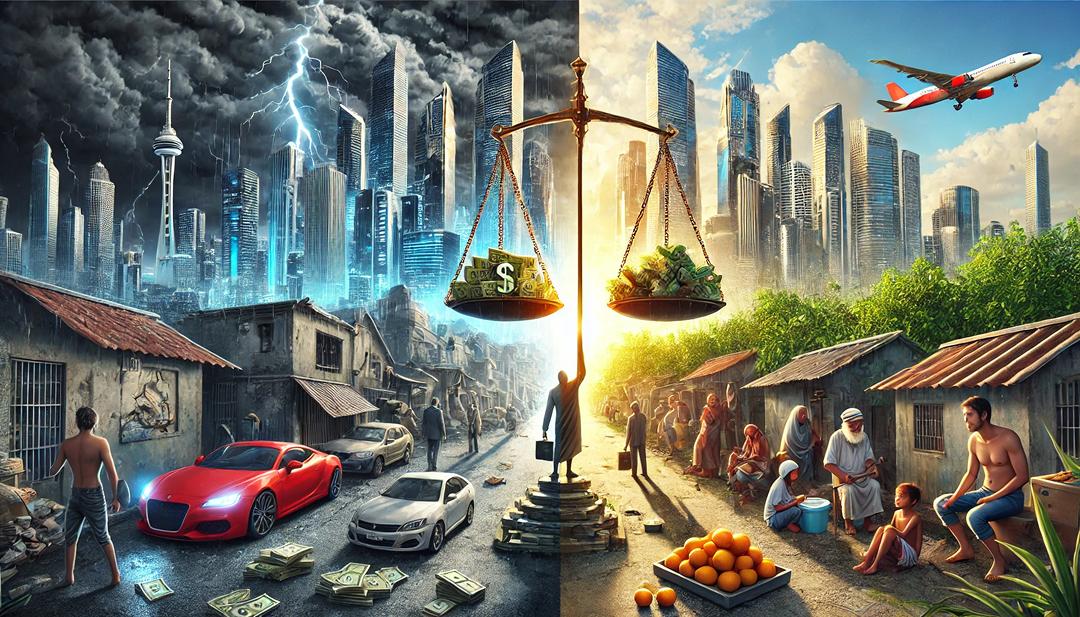


The Ethical Dilemma Behind Economic Disparity
As a child, I often wondered why humanity cannot achieve a level of productivity where everyone has enough to eat, a safe home, and access to education. We build magnificent airports but fail to construct basic schools with affordable books and teachers. Is this a problem of will, resources, or something else? Through my travels across the developing and developed worlds, I’ve come to realize the issue boils down to one thing: ethics.
India’s Financial Trajectory: Debt vs. Growth
Let’s examine India’s financial trajectory over the last three decades in units of INR ₹10¹² (lakh crore or LC):

For every rupee we earn, we accrue six rupees of debt. A third of our earnings go toward paying interest, and barely anything is allocated to principal repayments. From 2010-11 to 2023-24, we earned an additional ₹25 LC, but our debt soared by ₹143 LC.
External debt comes from foreign sources, while internal debt is borrowed domestically, primarily through instruments like government securities, treasury bills, and bonds held by banks, insurance companies, mutual funds, provident funds, and savings schemes. In essence, internal debt is the people’s money, entrusted to institutions to safeguard them.
As of today, the government has spent ₹181 LC of people’s savings. This is alarming. There’s no historical evidence or logical reasoning to believe this spending will lead to real growth. Over the last 15 years, for every ₹6 spent to "promote growth," only ₹1 has returned as earnings. Who ultimately pays for this debt? We do—but more significantly, our future generations. In other words, we are spending what our children are yet to earn.
Institutional Lending: A System of Coercion?
Why do financial institutions continue lending under such unfavorable terms? The answer lies in compulsion. Regulatory mandates require:
- Banks to invest over 18% of deposits in government securities.
- Provident funds to allocate more than 50%.
- Savings schemes, nearly 100%.
- Mutual funds, 10-100%, depending on the scheme.
- Insurance companies, 30-50%.
This isn’t credit-worthy investment; it’s coercion. When a system forces institutions to lend ₹6 to earn ₹1, we must ask: where does the other ₹5 go? The answer is clear: it is siphoned into the hands of a select few. Possibly, part of this builds infrastructure, but to what extent, if such projects do not generate increased earnings? Politicians, bureaucrats, and their accomplices operate as conduits, moving money under the guise of growth.
The Root of the Problem: A Crisis of Ethics
Before finding solutions, we must confront the core issue: a lack of collective responsibility and ethics. Too often, individuals focus on saving themselves without considering the larger ship sinking. This mindset led to India’s historical conquests by invaders. Today, the invaders come not with guns, but with bags of money. They enslave us, not with bullets, but with debt — not only us but also our future generations.
It’s a vicious cycle. A small, unscrupulous group exploits the masses, and an uneducated public fails to perceive or stop the exploitation. Both parties lack the ethics and vision needed for constructive and sustainable progress.
The Solution: A Return to Our Cultural Roots
The solution lies in returning to our cultural roots, which have sustained our civilization for millennia. Hindu philosophy teaches that the whole universe is one. There is no division between "I" and "you," "us" and "them," living and non-living. Imagine a glass of water on a table. Once you drink it, is the water now "you"? The distinction between self and other is an illusion. Division breeds conflict, conflict fosters fear, and fear justifies unethical actions.
If this sounds philosophical, it is. Philosophy is the foundation of understanding. Perhaps living without it for too long has left us uncomfortable with sensible thoughts. This discomfort reflects the state of the world today.
A Collective Path Forward
To solve our problems, we must act as one—no divisions, no conflicts, no fears. The path forward is simple: embody and enact the principles of unity. Only two futures are possible: collective success or collective failure. Let us choose wisely.


 Continue with Google
 Continue with Apple